The Completionist Trap: When a Film List Becomes Homework
A film watchlist can stay inviting without becoming homework. Use a seasonal review to preserve discoveries, clear stale reminders, and make room for new interests.
The most common film watchlist mistake is treating every saved title as a promise to watch it. The cost is that choosing a movie can begin with guilt instead of curiosity. A list meant to preserve discoveries starts to feel like a ledger of unfinished plans.
A seasonal review offers a different purpose. Rather than selecting a few films for the next stretch of evenings, it lets you notice how your interests have changed and what your saved titles reveal about them. The goal is not to build a temporary queue. It is to keep a record that still feels connected to the person you are now.
Why can a film watchlist become a record of old interests?
A title may have entered your list because of a friend’s recommendation, a festival program, a director you had just discovered, or a scene you glimpsed in passing. The reason can matter as much as the film. But as the list grows, those small sparks often disappear, leaving titles that seem to demand attention without explaining why.
That is how a record of curiosity can start to look like a plan. You may feel pressure to watch a film simply because it has been saved for a long time. Age on a list does not make a title more deserving than something that catches your attention tonight.
Keep the list as a record of interest, not a measure of follow-through.
How can a seasonal film watchlist review preserve discovery?
Choose a quiet moment at the turn of a season to read through the collection. You are not choosing what to watch next. Instead, look for patterns: perhaps several titles point toward a filmmaker, a place, a genre, or a question you still want to pursue.
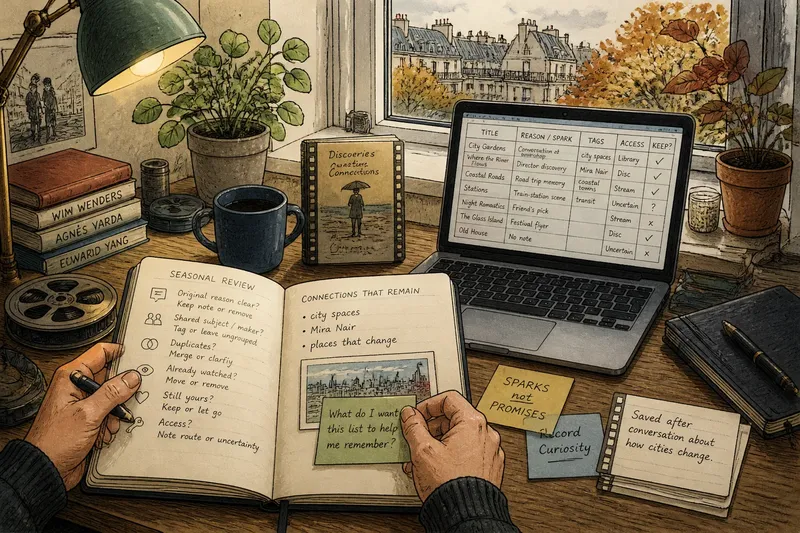
Use whatever holds the original notes: a film app, a spreadsheet, or a notebook. Add a short reason beside titles whose appeal you can still name. If a title has no note, pause to see whether it sparks interest now. You might also notice that a once-promising film no longer fits what you want to keep track of.
For example, imagine you saved a documentary after a conversation about urban gardens. During your seasonal review, you notice that you have since collected several films about how cities change. You add “city spaces” beside the documentary and the related titles, making the connection visible. The result is not a viewing assignment; it is a clearer record of a subject you may want to follow.
Keep a title because its connection or question still interests you. Remove it if the only reason to retain it is that it has been on the list for a long time.
What should a seasonal review check?
These checks help make the review a small act of care for the archive. For each one, choose the action that follows from what you actually see.
- Check whether the original reason is still clear. If a note such as “friend’s pick” or “train-station scene” still brings the interest back, keep the note; if the reason is unknown and the title no longer draws you, remove it.
- Check whether several films share a subject or maker. If the connection interests you, add a brief tag such as “Mira Nair” or “coastal towns”; if it does not, leave the films ungrouped rather than inventing a theme.
- Check for duplicate entries. If the same film appears twice under alternate titles, merge the entries or keep the one with the useful note; if they are different films with similar names, retain both and clarify the distinguishing detail.
- Check whether a title is already watched. If you have seen it and want to preserve a memory, move it to a viewing record or add a short note; if you do not need that reminder, remove it from the watchlist.
- Check whether a recommendation still feels like yours. If the film now interests you, keep the title and note who recommended it; if you only feel obliged by someone else’s enthusiasm, remove it.
- Check whether a title is available where you can reasonably watch it. If it is available through a library, a disc you own, or a service you already use, note that route; if access is uncertain, mark that uncertainty or leave the title in the archive without treating it as a current plan.
Make each decision once, then move on. A seasonal review should leave the collection easier to understand, not create a new sorting project.
What if your interests have changed?
Change is part of a collection’s history. A title you saved while exploring classic mysteries may no longer draw you, while a passing interest in animation may have become a lasting one. You do not need to defend either shift.
When a film stops feeling relevant, consider whether its context is still worth keeping. If it reminds you of a period of curiosity, a brief archive note can preserve that connection without leaving the title among films you may choose to watch. If the memory has no value to you, deletion is a reasonable end to the reminder.
For a title that still matters but not as a viewing prospect, record what you want to retain: the recommendation source, the director, or the subject. That small note can keep the discovery intact without asking the film to occupy the same place forever.
What questions help with a seasonal review?
Should I keep films I have ignored for years?
Keep them if the reason for saving them still interests you or if they preserve a useful connection. If they only create pressure, remove them or move the note about their original appeal to an archive.
Should a watchlist include films I have already seen?
It can, if you use the list to remember films you want to revisit or discuss. Otherwise, move watched titles to a separate viewing record so the list remains clear about its purpose.
What if I cannot remember why I saved a title?
Give it a moment of attention during the review. If it sparks a fresh question, keep it with a new note; if it does not, remove it or archive it without treating the missing explanation as a failure.
How often should I review the collection?
A seasonal review suits a collection that changes gradually, but the calendar is only a prompt. If the list becomes hard to read sooner, review it then; if it remains clear, there is no need to tidy it on schedule.
How can a film watchlist leave room for new discoveries?
A seasonal review does not have to produce a smaller list. It can make the collection more legible by restoring context, recording connections, and separating old interests from current ones. The useful question is not how quickly you can clear titles, but what you want the list to help you remember.
When you add a film, include the spark if you can: a conversation, a program note, a director’s name, or a subject you want to follow. When you return to the collection, let those notes guide your attention without turning them into obligations. A film watchlist works best as an evolving record of discovery, with room for the next interest to arrive unexpectedly.