A Watchlist or a Shortlist? Choosing What to Watch Next
A watchlist or shortlist can turn scattered film recommendations into a useful record and a clear viewing plan, without making discovery feel like homework.
The common mistake with a watchlist is treating it as a backlog to clear. That turns curiosity into an obligation: each film watched seems to make room for another, while titles chosen in passing lose the reason they appealed. A watchlist or shortlist works better when it records not just what you might see, but how a film entered your orbit.
That distinction matters because films arrive through different routes. A friend mentions one over dinner. A library program pairs another with a director talk. A streaming menu surfaces a third, then buries it. Keeping the source and a scrap of context can help you decide later whether the recommendation still speaks to you.
What should a film watchlist remember?
A watchlist can preserve the trail of discovery. Alongside a title, note where you encountered it and what caught your attention: a conversation, a repertory screening, a review, a director, or a particular image in the trailer. The note need not be polished. “Nadia mentioned the sound design” is more useful than a vague mark of approval if you later wonder why the film is there.
This approach makes the list an account of your curiosity rather than a measure of unfinished viewing. It also helps distinguish a film you want to seek out from one you saved because an app placed it in front of you. Both may be worth keeping, but they arrived by different paths.
If a title no longer interests you, remove it. You are not breaking a promise. You are updating a record of what you want to explore.
How can you make discovery easier to retrace?
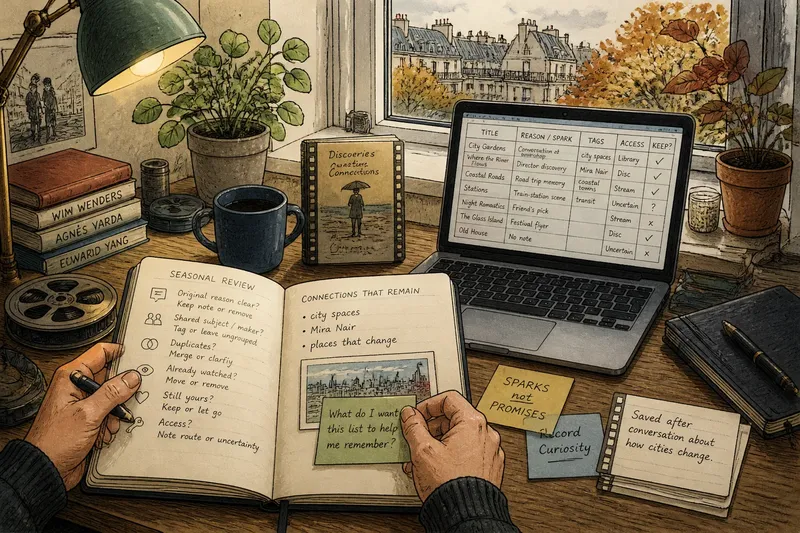
Give each saved film a small amount of provenance: the person, place, or prompt that brought it to your attention. A note app, a paper notebook, a library hold list, or a film journal can all serve. Choose a format you already use, so the record does not become a separate project.
Useful notes are concrete and brief:
- Person: who recommended it, if you may want to ask what they liked.
- Place: a cinema program, film-club meeting, museum series, or library display.
- Prompt: a director, performer, setting, theme, or filmmaking choice that drew your attention.
- Context: whether you want to watch it with someone, seek an introduction, or see it on a large screen.
- Access clue: where you saw it listed, if that detail will help you look again.
- Current interest: a few words about what appeals now, rather than a permanent judgment.
Each note should help with a later decision. If you cannot imagine using a detail, leave it out.
When does a shortlist help?
A shortlist is useful when a specific occasion calls for a decision. It might gather films for a visiting friend, a library’s weekend program, or a night when you want to follow a recommendation back to its source. Unlike a general queue, it has a reason to exist and a natural point at which to close.
Start with the occasion, then select titles that fit it. A group interested in a director’s early work might choose a film mentioned in a program note, another recommended by a friend, and a third already available through the library. Those are distinct routes into a shared evening. The shortlist lets everyone see the options without implying that one is objectively best.
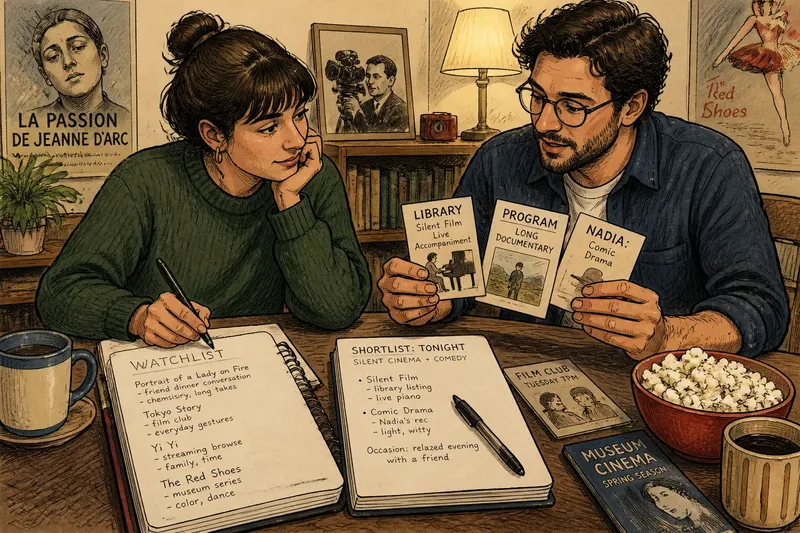
Say you have a note from your neighbor about a comic drama, a library listing for a silent film with live accompaniment, and a program card for a long documentary. You are planning a relaxed evening with a friend who is curious about silent cinema. You put the silent film and the comic drama on a temporary list, keeping the documentary on your broader watchlist because it does not fit this occasion. The result is a choice tied to the evening’s shared interest, while the other film’s discovery trail remains intact.
How do you choose between a watchlist and a shortlist?
Use a watchlist to collect possibilities over time. Use a shortlist to make a particular event easier to arrange. The difference is not the number of titles or the quality of the films; it is whether the list has a present purpose.
For a screening with friends, keep the shortlist visible to everyone and include the reason each title is under consideration. That can prevent a discussion from becoming a contest of taste. If no option suits the group, change the occasion or invite another suggestion. A list can organize preferences, but it cannot decide what everyone should enjoy.
For personal viewing, a shortlist can follow a thread of discovery. You might collect films by one performer after seeing a memorable role, or gather titles from a season at a local theater. If the thread stops feeling interesting, let the shortlist end. The watchlist can keep the remaining leads without requiring you to pursue them.
What questions help you keep film lists useful?
Should I record who recommended a film?
Record the person when their perspective is part of why you want to watch. A short note can also give you a natural way to ask what drew them to the film.
Is a film journal different from a watchlist?
A watchlist records films you may want to see; a journal can record what you thought after watching. They can live in the same place, but keep the distinction clear so an old reaction does not look like a current recommendation.
Should I keep films I can no longer find?
Keep one if the interest remains, and note where you last encountered it. If the title no longer matters to you, remove it rather than maintaining a search task you do not want.
What belongs on a shared shortlist?
Include the titles, the occasion, and a brief reason each person suggested an option. That gives the group something specific to compare without turning the list into a ranking of whose taste counts most.
How can you keep the record from becoming busywork?
Use only details that support discovery or a future choice. You do not need ratings, elaborate tags, or a schedule for reviewing every entry. A sentence fragment beside a title may be enough.
When you watch a film, decide whether its note still has a purpose. You might keep the source because you want to follow up with the person who recommended it, or clear the entry because the question has been answered. If a film leads you to another one, record that connection in plain language.
A watchlist or shortlist is most useful when it preserves the path that brought a film to your attention. Keep that path visible, and the next choice can begin with a conversation, a program card, or a thread of curiosity—not another effort to clear a queue.